
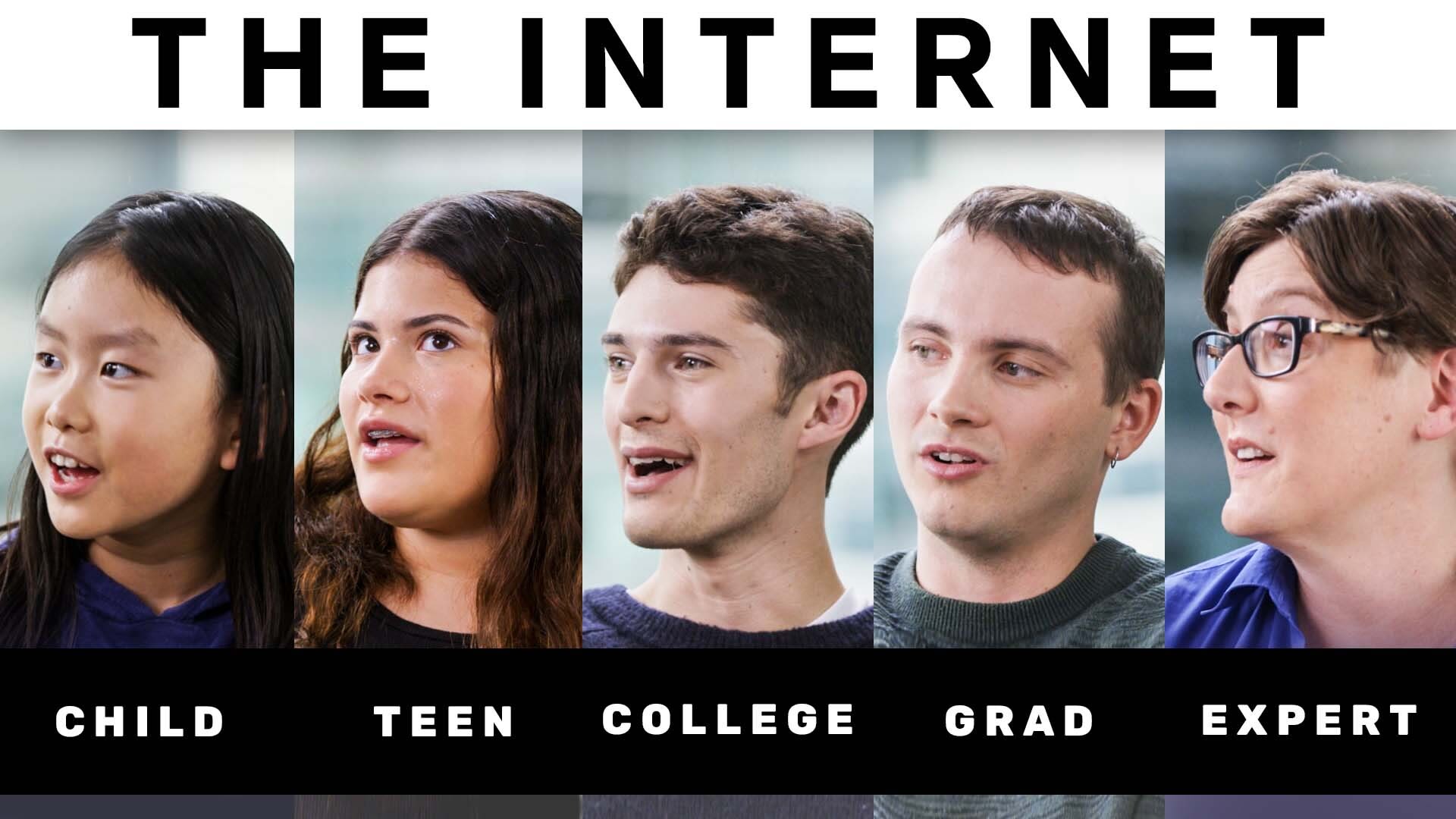
Watch UMass Professor Explains the Internet in 5 Levels of Difficulty | 5 Levels

Watch UMass Professor Explains the Internet in 5 Levels of Difficulty | 5 Levels

Hi, I’m Jim Kurose,

I’m a professor

at the University of Massachusetts at Amherst,

and I’ve been challenged to describe the internet

in five levels of increasing difficulty.

The internet is the most technically complex system

that humanity has ever built.

The internet is a network of networks.

It’s a platform on which all of the internet applications

that you’ve heard of can be built.

[bright music]

Hi, it’s really, really nice to meet you.

What’s your name?

My name is Skylar.

Skylar, we’re here to talk about the internet,

and I bet you must use the internet a lot, right?

Yeah.

What’s your conception about what the internet is?

The internet?

For me, it’s just something to use when I need

like to search up something or watch videos.

The internet is, physically, these computers

that all talk to each other.

Billions of computers, in the case of the internet.

The internet allows us to do

a lot of really, really interesting,

what we call applications.

You ever think about how that video gets to you

over the internet?

Yeah, I have no idea.

Got a favorite movie?

Matilda.

Matilda. All right.

We’re gonna actually build an internet.

I’ve got a couple of things here that I wanna show you,

or a couple of toys, actually.

Okay, let’s pretend that these round balls are computers.

And the internet is something that connects them.

And right now, the internet is just one communication link.

And Matilda is sent over the internet from this computer

to your computer.

So the internet is a network for carrying information

from one computer to another.

Now this network here looks pretty simple, doesn’t it?

Right? It’s just one thing.

Should we add some more friends in?

Yeah.

Let’s say we want to get a video from here, over to here.

How do you think that video would sort of travel

through this network?

Maybe it could go to here, to here, to here, to here.

That’s right.

So that’s pretty cool.

There are actually lots of different ways to actually go

through the internet to get from what we call a source,

the place that’s sending the information,

to the receiver, the place that’s actually gathering

the information together.

And that’s something we actually call routing.

Huh, but wouldn’t it just be easier

for it to go from here to here,

instead of going from here to here,

to here to here?

Yeah. So that’s a really good observation.

In most pieces of the internet,

that’s exactly what would happen.

We want to take what’s called a shortest path.

But still, there are multiple paths.

And why do you think that might be valuable?

Maybe one way is messed up or broken.

So you go the other way.

Exactly.

So, Skylar, that was a great discussion

about what we just built.

And I wanted to talk to you about,

or ask you about maybe one other really important

part about networks.

And it’s not

Read More

2022: UMass Technique announces $250,000 in Technological know-how Growth Fund awards

2022: UMass Technique announces 0,000 in Technological know-how Growth Fund awards
&#13
&#13

New systems aimed at lessening patients’ and health and fitness-care workers’ exposure to drug-resistant micro organism, detecting important ocean knowledge, and figuring out genetic diseases joined to autism and other health-related disorders could get nearer to market many thanks to $250,000 in seed funding announced now by University of Massachusetts President Marty Meehan.

10 faculty analysis tasks will each obtain up to $25,000 from the Technological innovation Advancement Fund, which aids to commercialize scientific breakthroughs all through the 5-campus University of Massachusetts. The fund is overseen by the Business office of Technological know-how Commercialization and Ventures (OTCV) at the UMass President’s Office environment in Boston.

“As a public exploration college, UMass has a responsibility to push innovation that strengthens the socio-economic fabric of our communities, nation, and planet,” mentioned President Meehan. “With these grants, we’re investing in planet class faculty who are carrying out our mission by way of their cutting-edge discoveries, attracting the maximum top quality collaborators, and bringing the benefits of research to the marketplace.”

The Know-how Development Fund awards present supplemental funding to support close the hole among UMass investigate discoveries and verified technologies that deal with the most pressing problems struggling with the location, the country, and the earth, usually laying the groundwork for big breakthroughs.

“These school assignments showcase how UMass proceeds to know very long-expression expansion and accomplishment in its commercialization business,” reported Carl Rust, Executive Director of Marketplace Engagement and Business enterprise Growth, who oversees the OTCV initiative.

The UMass process drives discovery and economic development in the course of the condition, conducting $752 million in once-a-year analysis and development in fields important to the Commonwealth’s economic climate. Pre-pandemic, the university produced $7.5 billion in statewide economic activity – a 10-to-1 return on expense by the Commonwealth.  UMass supports close to 50,000 work in Massachusetts, together with virtually 18,000 faculty and staff users and much more than 30,000 private sector employment. 

Considering that 2004, UMass has invested nearly $3 million in school R&D initiatives by the Know-how Advancement Fund. Jobs are decided on for their professional viability, in hopes that improvement of the technologies will lead to a startup enterprise or licensing arrangement. Funding for the annual awards will come from industrial licensing money on former college discoveries.

UMass proceeds to have a strong history of generating income from the commercialization of its educational exploration – $257 million around the very last 5 decades – and commonly spots between the major 25 universities in a countrywide study of profits created by know-how transfer.

This year’s recipients of the $25,000 Technological know-how Growth Fund awards are as follows:

Carlos Gradil, DVM, MS, PhD, DACT, Section of Veterinary & Animal Sciences – UMass Amherst 

This job is advancing a new ‘frameless’ magnetic contraceptive intrauterine system (IUD) based on physics and specially developed to conform to a female’s human body. The very long-acting magnetic product offers the very same efficacy as present IUDs, but with larger protection, straightforward insertion and elimination, and

Read More