
8 Powerful Steps To Outrank Your Competition With Targeted SEO

8 Powerful Steps To Outrank Your Competition With Targeted SEO

This post was sponsored by The Nine. The opinions expressed in this article are the sponsor’s own.

How do you ensure your website ranks ahead of the competition?

What hurdles could be causing you to rank lower than you’d like?

As a professional marketer, you understand how vital search engine optimization is.

By optimizing your site, you can improve your search engine rankings, increase traffic, and increase revenue by getting ahead of your competition with an in-depth SEO strategy.

But sometimes, there can be minor hurdles, such as execution, that can drop your location on search engine results pages (SERPs) by one or two positions.

After working with hundreds of websites, we’ve found that two things should be critical in your SEO process:

  1. Targeted SEO.
  2. The best possible technology stack in the industry.

We want to show you how targeted SEO works and the best practices for partnering with experts to achieve higher rankings.

1. Start With Targeted SEO & Keyword Research

Your website is only as good as its keyword research.

You know the power of a proven process. So let’s talk about the proven technique of Targeted SEO.

What Is Targeted SEO?

Targeted SEO refers to the practice of optimizing your website’s content and structure to attract a specific audience of potential customers who are looking for businesses like yours through search engines.

It involves using keywords, meta descriptions, and other on-page optimization techniques that align with the specific interests and needs of your target audience.

Targeted SEO is a practical solution that can morph into your specific SEO goals and targets.

The key to successful targeted SEO is understanding your audience’s search intent and behavior.

This means knowing:

  • Which keywords your audience uses when searching for products or services.
  • What questions your target audience frequently asks.
  • What type of content your audience prefers.

By incorporating this knowledge into your SEO strategy, you can create a website that is tailored to the needs of your target audience, resulting in:

  • Higher search engine rankings.
  • Increased traffic
  • Higher conversion rates.

What Is On-Page SEO?

Knowing and utilizing your audience’s keywords, questions, and preferred content types in the form of front-facing web content is often referred to as On-Page SEO.

On-Page SEO ensures your website is optimized for search engines and provides a great user experience.

It also includes the creation of new content based on your content strategy, which should center on skyscraper-style content and hub-style content.

These elements work together to increase organic search visibility and improve rankings.

Your goal is to not only boost your rankings but also engage

Read More

ChatGPT: Is Seo – As We Know It

ChatGPT: Is Seo – As We Know It

ChatGPT has taken the world by storm. Lots of have asked if it is the new way to do a search. This problem is intriguing given the most likely enormous impact on the search engine business enterprise room and the competitive components therein. Nonetheless, that is not the dilemma I inquire – in this post – I check out a similar query – if you have a business that has relied on Search Motor Optimization (Web optimization) for targeted traffic and relevance, exactly where does the ChatGPT depart you?

Chat vs Research

There is a elementary person intent big difference between chat and typical search (irrespective of who is offering the facility). Typical lookup returns a number of answers, requested in the fashion the search algorithm thinks is most appropriate to the question. Lookup success can go into a lot of internet pages. A Chatbot returns 1 or more solutions (but frequently just one), and additional than one answer is normally returned when the concern asks for a number of selections. Each methods are furnished by lookup right now – but imply diverse issues for Search Engine Optimization (Search engine marketing).

Allows get a quick illustration: I searched for “good cauliflower pizza crust recipe” on google. It returned about 25 distinct web-sites with recipes, as properly as tips to other associated questions. The same problem requested of ChatGPT returned 1 precise recipe in element, with a message that hoped I appreciate my pizza.

From a customer level of watch, either could be greater. If my purpose was to come across various recipes and do the work to select between them, the first is much better. If I just needed a recipe, the second is superior. Even so, the whole composition of Search Engine Optimization (Search engine optimisation) is primarily based on the initial. If my business enterprise is targeted on obtaining targeted traffic from folks searching for cauliflower crust recipes (and maybe advertising them other points these kinds of as pre-designed cauliflower crust), optimizing to rank increased on the first is a crucial Web optimization target. Full industries, greatest procedures, monitoring tools, and so on. exist to assist corporations reach this intention.

If shoppers choose the use the next tactic – wherever does it leave these firms? ChatGPT picked a one recipe – with no indicator of the supply. A follow-up question inquiring about the source exposed that the response was assembled from a lot of pieces of facts that the AI had gathered about recipes.

What does this necessarily mean for a business enterprise?

  • If your goal is to be found on a look for – how to get a instrument like ChatGPT to return your web-site as an response is not very
Read More

How to write title tags for SEO with ChatGPT

How to write title tags for SEO with ChatGPT

ChatGPT can be helpful for many SEO-related functions, including but not limited to local SEO, keyword research and SEO-focused content creation.

Title tags are another area the platform can help you with. Even if Google doesn’t always use them, title tags are still a critical on-page SEO element.

Even Google’s John Mueller acknowledged that ChatGPT could be helpful for creating page titles.

This article examines how ChatGPT and the ChatGPT API can help you create compelling, clickable title tags.

Before we dive in, keep the following caveats in mind:

  • The quality of your prompts will largely determine the quality of your responses.
  • ChatGPT is not an SEO tool, so it’s not explicitly designed to create SEO-friendly title tags.
  • You must always review and QA the tool’s output (it can often be wrong!).
  • The platform has a rough sense of text output and characters but doesn’t necessarily observe them precisely – an important point for title tag creation or editing. 
  • ChatGPT will only “remember” around 3,000 words of your chat.
  • The ChatGPT API won’t remember anything else but the prompt you’re applying at that moment and often ignores system messages.
  • You cannot fine-tune the ChatGPT API, but you can fine-tune the OpenAI API (which is more expensive than the ChatGPT API). 

For this article, I’ll focus on tasks you can do using either the ChatGPT web interface or the API. But you can extrapolate some of these and imagine how they may work with the Da-Vinci API or future versions of the ChatGPT API.

Let’s start by having the tool help me rewrite a title tag using some best practices.

If you have your own process, you can implement that. In this case, I will try to get ChatGPT to rewrite my title tags “like a pro.”

First, I’m going to take an article by Ross Hudgens at Siege Media about SEO title tag best practices and have ChatGPT analyze it:

ChatGPT prompt - title tag best practices

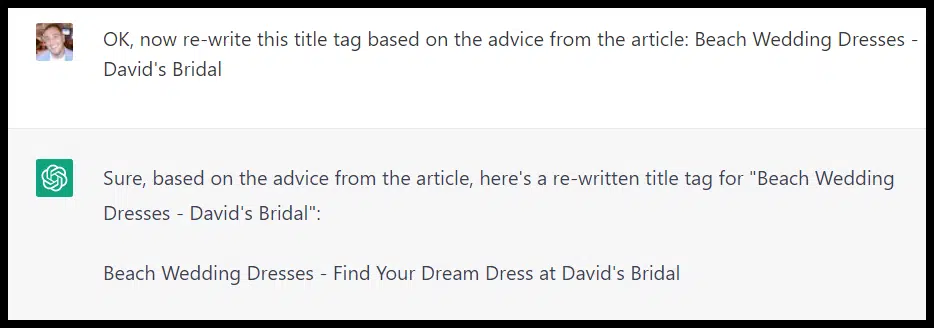
Next, I looked at the search results for “best beach wedding dresses” and grabbed a listing by David’s Bridal (just because it was ranking in the middle of the first page) and asked ChatGPT to rewrite their title tag:

David's Bridal - best beach wedding dresses

And here is what ChatGPT came up with after sharing the article and the title tag:

ChatGPT output title tag

Pretty interesting!

Let’s try the same thing, but this time with a different title tag process from Mike at Niche Twins:

Same approach here, I created a new chat (again: ChatGPT’s short memory!) and pasted in the contents of the thread and then asked ChatGPT to generate a new title tag based on Mike’s process:

ChatGPT output title tag - dream dress

ChatGPT does seem to have used a formula more in-line with the source, but it used a variation of “dream dress” again.

I’d opened a new chat for this prompt, so ChatGPT shouldn’t have used my previous prompt or result as context.

I asked it why it chose that

Read More

How ChatGPT can help you create content for SEO

How ChatGPT can help you create content for SEO

ChatGPT is top of mind for many people in the content creation and SEO spaces – and even seems to be a developing obsession inspiration to Google itself.

The biggest question for SEOs and people trying to create content to drive traffic from search engines is obviously:

How can ChatGPT help create content for SEO?

ChatGPT performs a few specific functions that can help you with content creation for SEO like:

  • Writing whole SEO-focused blog posts, articles, and landing pages.
  • Generating research you can use in SEO-focused content.
  • Performing specific SEO tasks to support your content creation, like keyword research or content clustering.
  • Creating embeddable elements and enhancements within your content to make the articles better and more linkable.

Sounds good, right?

The flip side is that while ChatGPT can be incredibly useful in some SEO content creation scenarios, it can also introduce risks for your sites. (Not to mention, it is still quite bad at several tasks.)

This article will walk you through some functions you can use to help you create content for SEO, alert you to some of the risks associated with some of them and discuss the areas where you might be better suited to use a different tool for the job.

Writing blog posts with ChatGPT

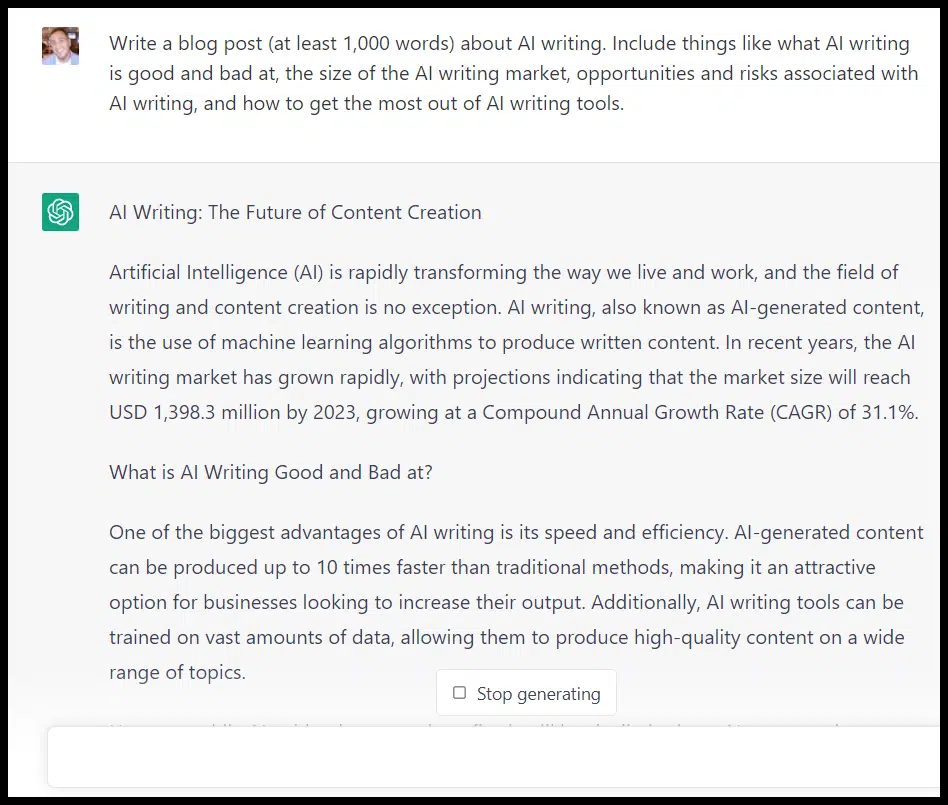
ChatGPT can write entire blog posts in a few minutes (and is not super humble about it if the output it generated is any indication): 

chatgpt-write-blog-post

Google has said their primary concern is whether AI content is “helpful” and that all their guidelines and recent updates (including E-E-A-T) will apply to AI content.

They recently wrote about this again, explicitly saying there is no “ban” on AI-generated content in Google search results.

As with many things in SEO, if your question is “does AI content work” the answer is really “it depends.”

If you have a very authoritative site like Bankrate or CNET, there might be a class of topics where AI content can rank very well, potentially even with minimal editing.

If you’re an independent publisher cranking out thousands of AI-generated blog posts, or you’re just a less authoritative site pushing out lots of AI content, you may not be so lucky (see Mark Williams-Cook’s example in the first comment here):

As you can see his graph was moving up and to the right for a while (until it wasn’t). 

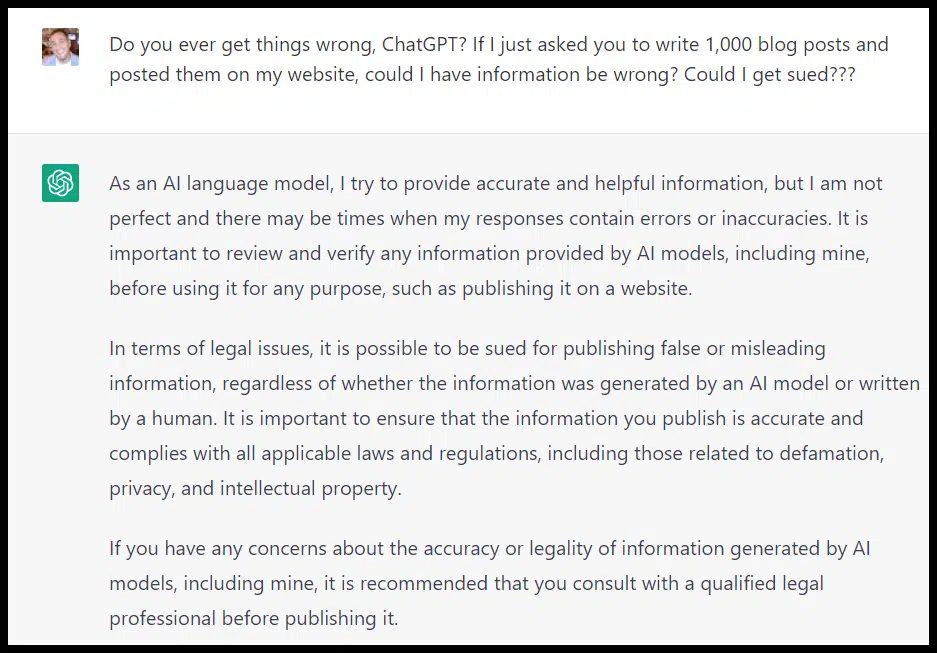
If you’re running a business, you also have to worry about the accuracy of ChatGPT’s content, as you would with in-house or freelance writers.

There are many things that it just gets wrong, as the tool itself will admit:

chatgpt-inaccurate-information

So whether you can run with intact ChatGPT content is a question of what you’re trying to accomplish and your risk threshold.

Creating subsections, meta descriptions and short content blocks

While you want to be careful with the amount of content you let ChatGPT run wild on, you can do a few things to make the content it produces more useful:

  • Specific prompts: Give very specific prompts about
Read More

How to update content and dates for SEO in 2023

How to update content and dates for SEO in 2023

Every new year, SEOs, bloggers and publishers are eager to capitalize on “fresh content” ranking boosts by adding new dates to old or existing content. 

Google’s search advocate John Mueller again reiterated that only significant content changes should lead to a changed date in articles.

But what is considered significant? And what does it really mean to change a date?

Both depend on many factors. As always, there is middle-ground to cover so let’s dig deeper in this article. 

The evolution of fresh content ranking boosts

There was a time when updating content did not help attract visitors on Google. Then over the years, Google increasingly rewarded “fresh content.”

Do you remember the concept of “query deserves freshness” (QDF)? 

As early as 2007, former Google SVP Amit Singhal discussed how the algorithm considers searchers’ need for current information.

The QDF model aims to measure, assess and rank content based on its value for a particular (time-sensitive) search query. It was among the first algorithm tweaks meant to take user intent into account.

This meant that less authoritative but newer content would sometimes outrank high-quality but older content because some searches require current results than others. 

The example below shows a Google search for [us elections] in January 2023:

Elections

When you click the “Overview” button on top, you will get another results page with even more current results covering primarily the latest election that will take place next. (Here the “2023 United States House of Representatives elections.”)

When you search for election results, you most likely don’t want to see results from the past election (even though they have earned many links ever since). You’d want results from this election, which may not have attracted as many links yet in a short time.

In the past, the article date indicated to Google which resource was newer. Only a limited number of keywords were affected at first, and this still does not apply to all search queries.

Some SEOs started gaming this ranking signal quickly. They changed the date automatically, sometimes every day. Others removed the dates to at least not look outdated.

All this forced Google to dig deeper into the actual content’s value.

The Google algorithm has significantly changed since, but QDF is still present among other freshness systems. 

“We have various “query deserves freshness” systems designed to show fresher content for queries where it would be expected.”

– A Guide to Google Search Ranking systems, Google Search Central

This is still one of Google’s unique selling points. They have a fresher index compared to Microsoft Bing. 

Bing and alternative search engines, still heavily rely on site authority as measured by incoming links and overall trustworthiness. This works fine for some keywords but is stale for others.

What is considered ‘significant’ when updating content?

As Google heavily invests in its helpful content system and other AI-based ranking algorithm tweaks, you can rest assured that it looks beyond just an article’s date. 

The good news is that you

Read More

5 Ways To Drastically Improve The ROI Of Your SEO Strategy

5 Ways To Drastically Improve The ROI Of Your SEO Strategy
5 Ways To Drastically Improve The ROI Of Your SEO StrategyScreenshot from Pi-Datametrics.com, January 2023.

In the chart above, you can see that a “target” zone has been identified within Pi Datametrics Market Intelligence‘s Estimated Revenue Opportunity.

Content for these key terms is ranking well enough, but it’s currently sitting outside the positions that get the highest number of clicks (and ultimately, revenue).

Once you have identified this low-hanging fruit, it’s a great place to focus your efforts and optimize accordingly.

There are often easy fixes within this target area, for example, sorting out internal linking causing content cannibalization.

If you can also identify how much additional revenue you would gain from improving this target content; this will help you build internal business cases for getting technical website fixes into release cycles.

How To Capitalize On Medium-Volume Keywords

  1. Identify: Find and identify content where the opportunity has already been established and you have content that already exists. Look at the content you have sitting on pages 2 and 3 of Google.
  2. Prioritize: Focus on the terms with the highest revenue opportunity in order to see a quick impact on performance numbers and goals.
  3. Optimize: Once you’ve prioritized which terms to focus on first, go through each page one by one and optimize accordingly.

3. Optimize Your Content For Informational Searches

Optimizing for long-tail searches is key to capturing your audience at multiple touchpoints before conversion.

One of the best places to start is looking at the questions your audience is asking within the People Also Ask feature of Google search.

You can do this easily with Pi Datametrics People Also Ask Explorer, as seen below.

5 Ways To Drastically Improve The ROI Of Your SEO StrategyScreenshot from Pi-Datametrics.com, February 2023.

Having a good grasp and understanding of your audience’s intent can help inform your content so that it aligns with your customer and their needs.

Google’s People Also Ask feature is a really useful tool to get inside the mind of your customer and have a clearer picture of the content they’re searching for.

Use it to explore which questions on the SERPs relate to your product and key search terms.

Then, create and optimize your content so that you answer these questions and provide your customer with the information they’re looking for, before the point of purchase.

Our research suggests that if a customer views an “informational” page before a product page, they are more likely to convert, have a higher average order value (AOV), and also be a repeat customer.

Top Tips For Influencing Your Audience Before Conversion

  1. Utilize Google’s People Also Ask feature to get inside the mind of your customer and anticipate the queries they ask Google in relation to your product.
  2. Ensure your content is optimized to answer these queries, and if it’s not, think about adding new content to your strategy.
  3. Don’t forget about other SERP features. They all provide new opportunities to get your content in front of your customers and open more doorways to your site.

4. Maximize Opportunities From The Entire SERP

Read More