10 Essential Priorities For Your Retail SEO Strategy

10 Essential Priorities For Your Retail SEO Strategy

Ecommerce is expected to reach almost 35% of sales among big-box retailers worldwide by 2023, rising from 23% in 2019, according to Edge Retail Insight.

This growth is expected to continue, with ecommerce taking a nearly 40% share of sales by 2025.

This comes amid strong online growth and stable or declining physical store sales worldwide.

However, store-based retail nevertheless continues to account for the majority of sales. Additional research shows consumers prefer a mix of online and offline shopping.

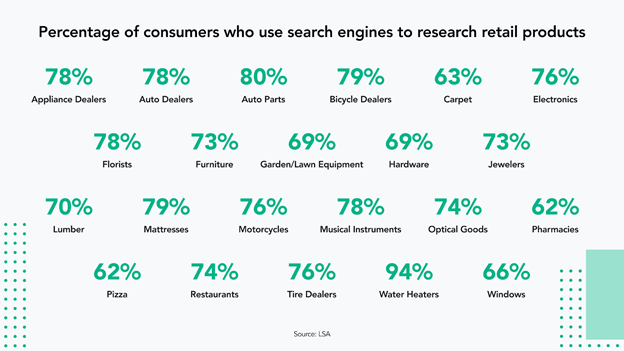
Regardless of how the transaction is carried out, the majority of shoppers use search engines for discovery and comparison shopping.

How consumers use search engines for various retail discovery.Image from LSA, February 2022

That means that whether customers are shopping in your store, on your website, or via a social commerce platform, SEO is an area of opportunity retailers cannot afford to miss.

Here are 10 top priorities for your retail SEO strategy.

1. Keyword Research

Keyword research is extremely important for retail brands. Knowing what keywords consumers are searching for and how they are searching is vital to building out your informational architecture and content strategy.

It should cover keywords at all stages of the fragmented user journey:

  • informational,
  • navigational,
  • transactional,
  • and intent-based.

There are a plethora of keyword research tools, but always make sure to review your competitors’ keyword research strategy, too.

That includes Amazon because of the high purchase intent there. Use Amazon’s keyword tool, as well as tools like Ahrefs.

Once the site is up and running, review paid search data and find keywords that are converting and driving traffic and sales.

Make sure the site is ranking on the first page wherever possible of all the major search engines for those keywords through ongoing optimization.

This will help you augment organic performance initially but then reallocate your paid budget over time as SEO proves its value.

2. Local Search

Getting found online is key to driving traffic and sales.

It’s a simple truth that the more you show up for your customers, the more your business thrives and can provide services.

But when it comes to local search, accuracy matters.

So get on a good local search platform and then claim and optimize your listings.

Optimized listings help your retail brand show up at the top of local searches and provide a consistent customer experience to drive acquisition and retention.

Make sure you are taking advantage of Google Business Profiles, a tool that helps businesses manage their presence across Google properties, to share updates with your customers.

Add photos to your GBP listings to improve the customer experience, add attributes so customers know what to expect, display your products and inventory, submit relevant categories, respond to Q&A, and also monitor and respond to reviews.

I can’t tell you how many retail brands still don’t respond to reviews, both good and bad.

To learn more about how to optimize for local search, read the Definitive Guide to Improve Your Local Search Rankings.

3. Structured Data

Structured data can help

Read More

Battery technology and recycling alone will not save the electric mobility transition from future cobalt shortages

Battery technology and recycling alone will not save the electric mobility transition from future cobalt shortages
  • van Vuuren, D. P. et al. Alternative pathways to the 1.5 °C target reduce the need for negative emission technologies. Nat. Clim. Change 8, 391–397 (2018).

    ADS 

    Google Scholar
     

  • Kitzing, L., Jensen, M. K., Telsnig, T. & Lantz, E. Multifaceted drivers for onshore wind energy repowering and their implications for energy transition. Nat. Energy 5, 1012–1021 (2020).

    ADS 

    Google Scholar
     

  • Li, J. et al. Critical rare-earth elements mismatch global wind-power ambitions. One Earth 3, 116–125 (2020).


    Google Scholar
     

  • Rasmussen, K. D., Wenzel, H., Bangs, C., Petavratzi, E. & Liu, G. Platinum demand and potential bottlenecks in the global green transition: a dynamic material flow analysis. Environ. Sci. Technol. 53, 11541–11551 (2019).

    ADS 
    CAS 
    PubMed 

    Google Scholar
     

  • Hao, H. et al. Impact of transport electrification on critical metal sustainability with a focus on the heavy-duty segment. Nat. Commun. 10, 5398 (2019).

    ADS 
    PubMed 
    PubMed Central 

    Google Scholar
     

  • Cao, Z. et al. Resourcing the fairytale country with wind power: a dynamic material flow analysis. Environ. Sci. Technol. 53, 11313–11322 (2019).

    ADS 
    CAS 
    PubMed 

    Google Scholar
     

  • International Energy Agency, (IEA). The Role of Critical Minerals in Clean Energy Transitions. https://iea.blob.core.windows.net/assets/24d5dfbb-a77a-4647-abcc-667867207f74/TheRoleofCriticalMineralsinCleanEnergyTransitions.pdf (2021).

  • Melton, N., Axsen, J. & Sperling, D. Moving beyond alternative fuel hype to decarbonize transportation. Nat. Energy 1, 16013 (2016).

    ADS 

    Google Scholar
     

  • Kittner, N., Lill, F. & Kammen, D. M. Energy storage deployment and innovation for the clean energy transition. Nat. Energy 2, 17125 (2017).

    ADS 

    Google Scholar
     

  • Dunn, J., Slattery, M., Kendall, A., Ambrose, H. & Shen, S. Circularity of Lithium-Ion Battery Materials in Electric Vehicles. Environ. Sci. Technol. 55, 5189–5198 (2021).

    ADS 
    CAS 
    PubMed 

    Google Scholar
     

  • Executive Office of the President of the United States Federal Government. Addressing the Threat to the Domestic Supply Chain From Reliance on Critical Minerals From Foreign Adversaries and Supporting the Domestic Mining and Processing Industries. https://www.federalregister.gov/documents/2020/10/05/2020-22064/addressing-the-threat-to-the-domestic-supply-chain-from-reliance-on-critical-minerals-from-foreign (2020).

  • Ministry of Natural Resources & National Development and Reform Commission of the People’s Republic of China. National Mineral Resources Planning 2016-2020. https://www.ndrc.gov.cn/fggz/fzzlgh/gjjzxgh/201705/t20170511_1196755.html (2016).

  • Blengini, G. A. et al. Study on the EU’s list of Critical Raw Materials (2020) Final Report. https://op.europa.eu/en/publication-detail/-/publication/c0d5292a-ee54-11ea-991b-01aa75ed71a1/language-en (2020).

  • The Ministry of Economy, Trade and Industry of Japan, (METI). New International Resource Strategy. https://www.meti.go.jp/english/press/2020/0330_005.html (2020).

  • Mudd, G. M. et al. Critical minerals in Australia: A review of opportunities and research needs. https://doi.org/10.11636/Record.2018.051 (2018).

  • Hao, H. et al. Securing platinum-group metals for transport low-carbon transition. One Earth 1, 117–125 (2019).


    Google Scholar
     

  • Fishman, T., Myers, R., Rios, O. & Graedel, T. E. Implications of emerging vehicle technologies on rare earth supply and demand in the United States. Resources 7, 9 (2018).


    Google Scholar
     

  • Roskill. Cobalt: Outlook to 2030. https://www.roskillinteractive.com/ (2021).

  • Alves Dias, P., Blagoeva, D., Pavel, C. & Arvanitidis, N. Cobalt: demand-supply balances in the transition to electric mobility. https://data.europa.eu/doi/10.2760/97710 (2018).

  • U.S. Geological Survey. Mineral Commodity Summaries 2020. https://doi.org/10.3133/mcs2020. (2020).

  • Dehaine, Q., Tijsseling, L. T., Glass, H. J., Törmänen, T. & Butcher, A. R. Geometallurgy

  • Read More

    OneWeb satellites caught in Russia Roscosmos standoff amid Ukraine crisis

    OneWeb satellites caught in Russia Roscosmos standoff amid Ukraine crisis

    A Soyuz 2 rocket launches 36 OneWeb satellites on March 25, 2020 from Vostochny Cosmodrome, Russia.

    Roscosmos

    The company world-wide-web room race has taken a geopolitical change.

    Russian area agency Roscosmos is refusing to start the upcoming batch of 36 OneWeb net satellites as scheduled for Friday, except the organization fulfills the condition agency’s calls for. Roscosmos head Dmitry Rogozin reported the ultimatum is a response to U.K. sanctions against Russia around its invasion of Ukraine.

    Roscosmos claimed in a statement on Wednesday that the Soyuz rocket will be eradicated from the launchpad at Baikonur Cosmodrome in Kazakhstan unless OneWeb meets two calls for:

    • The U.K. governing administration sells its stake in the enterprise.
    • OneWeb ensures that the satellites not be applied for military uses.

    U.K. Organization and Electricity Secretary Kwasi Kwarteng reported in a assertion that there is “no negotiation” with Roscosmos about OneWeb and that the government “is not promoting its share.”

    “We are in touch with other shareholders to talk about upcoming ways,” Kwarteng mentioned.

    In flip, Rogozin responded to Kwarteng by indicating he would give the U.K. two days to think about its conclusion, and implied that OneWeb would not be capable to full its satellite network with no Roscosmos’ assist.

    OneWeb’s chief of government, regulatory and engagement Chris McLaughlin told CNBC that in the meantime, the firm has taken out its staff from Baikonur Cosmodrome – as Russia leases the spaceport. McLaughlin reported OneWeb’s workforce on site, as effectively as a U.S. Point out Section security agent, are now all safely offsite and relocated somewhere else inside of Kazakhstan.

    “We have not been complacent – we’ve been wanting after, as a priority, the safety and stability of our men and women and of our compliance with ITAR [International Traffic in Arms Regulations],” McLaughlin explained.

    Arianespace, a subsidiary of European rocket builder ArianeGroup, has also relocated its staff in coordination with the OneWeb teams. The corporation sells rockets, which includes the Soyuz, that are supplied by Roscosmos for OneWeb launches. Arianespace declined CNBC’s ask for for remark on the predicament.

    A stack of 36 OneWeb satellites getting ready in advance of its start on March 25, 2020.

    Arianespace

    OneWeb has released 428 satellites to low Earth orbit on Soyuz rockets and programs to function a constellation of 650 satellites to provide world-wide net coverage from place.

    McLaughlin claimed that OneWeb has been getting data about the problem the exact same way that the community is: by tweets by Roscosmos and Rogozin.

    “It’s all we’re acquiring,” he stated. “It sounds ridiculous but I’ve viewed the letters [to OneWeb from Roscosmos], and the letters say absolutely nothing that isn’t really already in the tweets.”

    As McLaughin understands it, Roscosmos will have a assembly on Friday night, at which point — if the calls for are not satisfied — the Russian space company would formally declare it really is not launching the OneWeb mission, roll the rocket again from the launchpad and disassemble it.

    OneWeb’s satellites arrived in Kazakhstan

    Read More

    I Give up Amazon Supply to Start a Internet-Design Company

    I Give up Amazon Supply to Start a Internet-Design Company
    • Diego Diaz, 23, established Ammo Studio, a internet site development agency, in February 2021.
    • He remaining employment in protection, at Amazon, and in social media to go after his dream of working in tech.
    • This is Diaz’s tale, as advised to writer Perri Ormont Blumberg.

    This as-informed-to essay is based mostly on a conversation with Diego Diaz, a 23-calendar year-previous world wide web designer and the founder of Ammo Studio based in Los Angeles, California. It has been edited for length and clarity.

    This story is component of “How the Pandemic Transformed My Vocation,” an Insider series documenting the moves and times that formed people’s occupations in excess of the previous two many years.

    At the starting of the pandemic, I was doing work graveyard shifts as a stability guard. It was challenging, in particular when I labored outdoors an emergency place and experienced to witness the results of COVID-19 firsthand.

    I was also worried about remaining allow go due to virus circumstances spiking. It was far from my aspiration position, but it arrived with a paycheck, so I stuck with it.

    man sitting in a car wearing a security shirt

    Diaz as a security guard.

    Courtesy of Diego Diaz


    I have often had aspirations of doing work in tech, but I never knew rather how to get there with no a official coding or software package engineering history. I would been trying to instruct myself how to code for a long time employing YouTube, Codecademy, and Visible Studio Code without achievements. I hardly ever stopped seeking, while, and would carry my computer with me for my shifts to help go the time. 

    In February 2021, I launched Ammo Studio, an skilled internet site progress agency utilizing Webflow, a web page that teaches people today to create web sites from scratch without needing to code.

    In early 2020, I came across an advert for Webflow

    This was my initially introduction to the “no-code” neighborhood, and it instantly caught my interest. I began to research Webflow and searched for the business on Twitter. I arrived across the broader no-code group there and understood in my gut that this was my possibility. 

    In excess of the upcoming number of months, I continued to exploration Webflow and build connections within just the no-code neighborhood, but I did not have the time to dig into it further more.

    At the end of 2020, I give up my career as a security guard and discovered a new career as an Amazon supply-driver helper performing physical labor 

    Getting to wake up at 4:30 a.m. and do the job 10-hour times lifting packages among 50 and 300 lbs . was exhausting, so I continued to glimpse for my way out. 

    Amazon driver wearing a mask

    Diaz doing work an Amazon shift.

    Courtesy of Diego Diaz


    I chilly-emailed a organization in the no-code space and by some means managed to get a social-media work there with no startup expertise.

    I emailed the founder, established up a phone, then experienced to produce a blog submit before they manufactured

    Read More

    A Comprehensive Guide For Sellers

    A Comprehensive Guide For Sellers

    In digital marketing, we talk a lot about what you need to do for your website and how to make it SEO-friendly for users and search bots.

    But how much do you know about Amazon SEO?

    If you’re an ecommerce business and you’re not on Amazon in 2022, you may not be hitting your sales potential.

    Amazon’s a powerhouse, a workhorse, an old reliable when it comes to e-commerce, as most people should be aware of by now.

    Everyone wants to get their products on Amazon because that’s where their audiences shop.

    And those audiences shop the platform quite a bit.

    Amazon generates about $4,722 every second, or about $17 million an hour. The sales giant closed out last year with $469.8 billion in net sales, up 22% over 2020.

    That’s why sellers want a piece of the action, and why it can be so difficult to rank your products on Amazon’s results pages.

    As with your website, though, you can practice Amazon SEO to give your products a boost.

    It’s all about understanding the algorithm, what shoppers are searching for to find what they need, and how you can outperform your competitors.

    Here’s a comprehensive guide to Amazon SEO for sellers.

    How Amazon’s A9 Algorithm Works

    Before we can talk about Amazon SEO and how you can optimize your product listings, it will help to understand how Amazon’s A9 search algorithm works.

    It’s similar but not identical to Google’s.

    One main difference?

    Amazon queries are only commercial, rather than navigational or informational as with Google.

    Think about it simply.

    You make a search. A9 knows you want to buy whatever you searched.

    It matches the query to a group of relevant products, and you are shown those products on a series of pages.

    How does Amazon even select those particular products, though?

    Again, think about it like Google’s algorithms, but exclusively for ecommerce.

    The factors Amazon considers for rankings include:

    • Positive customer reviews (better products will sell more and make more money for Amazon).
    • Historical sales.
    • Relevant keywords included in the product listing.
    • The right prices (not too high, not too low, based on the competition).

    It’s important to note here that while the algorithm is always looking for relevance based on a query, historical data matters a lot, too, as pointed out in the above list.

    The results that have pleased customers in the past are likely to please customers in the future.

    New sellers on Amazon are therefore faced with a dilemma: if Amazon prioritizes products with strong sales, but you haven’t made any sales yet or generated any historical data for A9, how can you ever hope to climb Amazon’s rankings?

    The answer lies in performing Amazon SEO, starting with the keyword research that can get you found by the shoppers who matter to you.

    Performing Amazon Keyword Research

    Just like with Google, an Amazon SEO strategy must be built on keyword research.

    Without the right keywords in your rankings,

    Read More

    How the pandemic changed the way health tech is developed

    How the pandemic changed the way health tech is developed

    Good afternoon! Last week marked the two year anniversary of the World Health Organization calling COVID-19 a pandemic, so we asked the experts to reflect on the way health tech products get developed and go to market has changed in that time. Questions or comments? Send us a note at [email protected].

    Angela Yochem

    EVP, Chief Transformation and Digital Officer at Novant Health, and Chief Operating Officer (COO) at Novant Health Enterprises

    Prior to the pandemic, health care companies and their software vendors were not generally known for rapid development of new functions, granular levels of responsiveness, fluid roadmaps or in some cases even iterative or agile creation methods. Because the consumers of their products were slow and careful adopters, there was no reason to optimize for speed.

    The onset of the pandemic compelled these organizations to rapidly build new functions into their products and platforms, as they were forced to incorporate pandemic-related workflows, data sets and functionality in response to the emerging challenges. This tested their appetite for rapid roadmap evolution, their ability to quickly deploy, pivot and deploy again and their ability to make decisions quickly, while still maintaining highest degrees of quality.

    Meanwhile, with change comes opportunity — and many new entrants joined the health care ecosystem during the pandemic, creating an environment of greater competition and increased fragmentation. So the general sense of urgency continued to expand, even as the pace of delivery caught up with the demands created by pandemic response.

    As a result, speed is now top of mind for all health tech creators. Some have adopted a more rapid and iterative approach to product management, others have streamlined their path to launch of new functions or components and still others have significantly edited their planned roadmap for the next few years. But the most interesting change I’ve seen is the willingness to co-create solutions with a variety of entities across the health care ecosystem. Coopetition is the new way forward, particularly in the face of such enhanced competition, and my belief is that jumping on those co-creation opportunities with unconventional partners will be the way that every product company in health care (and other industries) will compete in the coming years.

    Tweet this.

    Amit Phadnis

    Chief Digital Officer at GE Healthcare

    Yes.

    Hospitals are under immense capacity and financial pressures. They need rapid plug-and-play tools that combine different data streams from different points of care to drive productivity and improve patient outcomes.

    The rapid increase in patient volume from COVID-19 necessitated hospitals have a holistic picture of the resources they had available — beds, PPE, staffing, etc. In fact, at GE Healthcare we’ve had hospital CEOs remark that they’ve made more progress on digitization than they ever thought they would in the next five or seven years.

    Looking ahead, the process of developing new technology is focused around utilizing the vast amounts of data that exists, refining it and making it interoperable so it can be combined with other data sets and third-party

    Read More