How Do I Start out To Attain Working experience In Research? Inquire An Seo

How Do I Start out To Attain Working experience In Research? Inquire An Seo

This Ask An Website positioning problem comes from Jessica from Louth, who wrote in:

“I’m at present a comprehensive-stack marketer but obtain myself drawn to Seo.

I’m not certain exactly where to commence attaining working experience, although.

What path would you propose to start off in and do you have any e book/training course recommendations?”

Studying Search engine optimisation can be daunting.

I have been doing the job in look for engine optimization professionally considering that 1998 (which is 23 a long time for any one counting), and I nonetheless learn new items each and every day.

But that does not necessarily mean that aspiring Seo pros are out of luck.

Rather the opposite.

A lot of terrific assets are out there for novice lookup motor entrepreneurs to sink their teeth into.

And compared with when the other “Original Gangster” Web optimization specialists and I uncovered the craft, there are some set up sources that (practically) anyone agrees are good places to start.

A Term Of Caution

Even the most effective guidance is almost never common.

What will work on 1 web site very very well may well drop flat on one more.

The only way to know if an Search engine optimization tactic is effective for you is to test it.

You can go through theories about algorithms and code tweaks frequently, but right until you put these theories into exercise on your web-site, you never know if they will do the job.

Even if you bodily see evidence of how very well a approach labored on one more site, there is no assurance the very same system will end result in similar benefits when implemented.

Simply set, you never know something right until you exam it.

But reading other Search engine marketing execs chat about their operate is section of the task.

You will be astonished at the suggestions our field generates day-to-day.

If you aren’t interested in examining what other Search engine marketing industry experts are executing, you are in all probability in the completely wrong area.

Loads Of Destinations To Study The Basic principles

Search engine optimisation isn’t rocket science.

I evaluate it far more to plumbing.

I can in all probability determine out how to fix a sink by looking at YouTube movies, but I’ll in all probability flood my property.

Just after all, the only detail in my toolbox is a checkbook.

If you are intrigued in getting into Seo, you could possibly flood a couple of sinks at to start with.

But if you have a simple knowing of how internet websites do the job and are ready to place the time and effort into understanding the craft, you’ll before long be the a single every person calls to repair their proverbial sink.

You can learn the essentials in different techniques.

Some people want to make their individual web site and experiment until finally they know what functions for them.

Other individuals desire to find out from on the net courses like

Read More

10 Ways To Optimize Your Site For Future SEO Success

10 Ways To Optimize Your Site For Future SEO Success

Additionally, Google is working on upgrading its search capabilities through AI technology like MUM, which promises to make search more flexible.

This valuable knowledge will push you towards the best way to optimize your site.

Let’s make sure your SEO strategy matches the flexibility of your customers and Google’s constantly changing algorithm.

How To Optimize Your Site For Voice Search

Now that we know how people typically use voice search, let’s get to work.

Making your site voice-search-friendly can help people find you – and, more importantly, choose you.

How can your business leverage voice technology?

1. Find & Use Conversational Keywords

As you know, short and vague keywords are the enemy of SEO.

In most cases, mid-tail and long-tail keywords are much better: the more specific they are, the more likely they are to bring you a customer.

Voice search takes it a step further: even long-tail keywords aren’t enough.

Instead, you have to use full phrases and questions that are normally used in conversations between real humans.

Such as, “What is the airspeed velocity of an unladen swallow?”

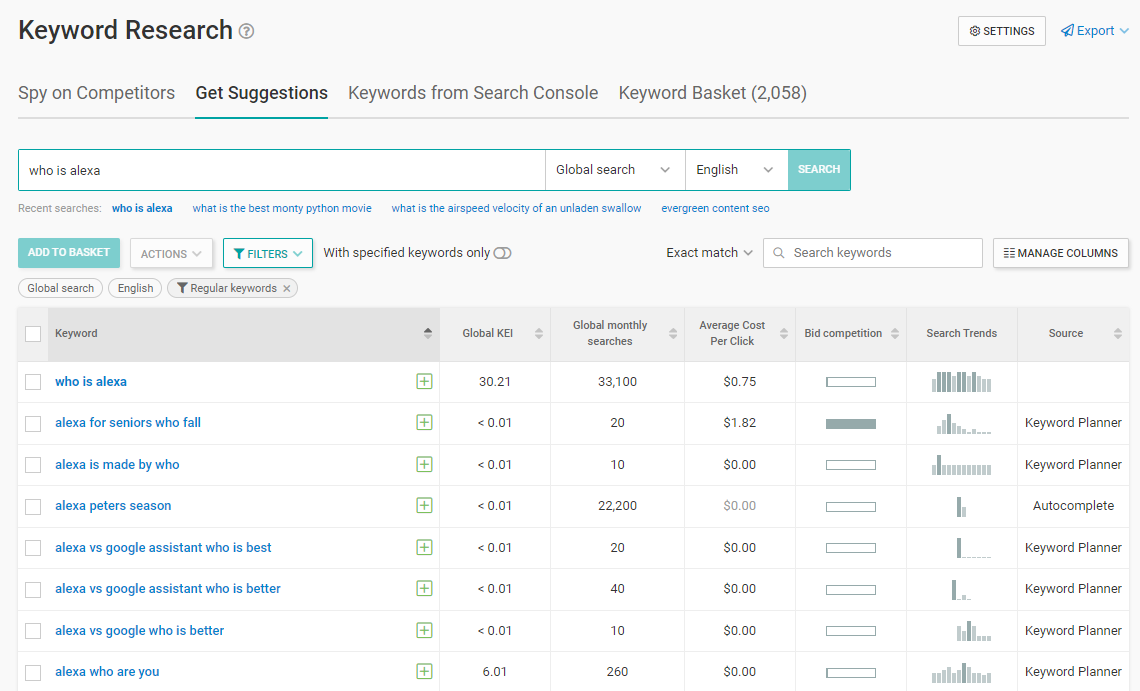
Fortunately, keyword-finding tools can pick up such phrases and questions for you just fine.

Look no further than WebCEO’s Keyword Suggestions.

Voice Search: 10 Ways To Optimize Your Site For Future SEO SuccessScreenshot from WebCEO, April 2022

Once you’re inside the question research tool, select all conversational phrases.

Hint: they often begin with the words who, what, why, where, when, and how.

Good alternatives for voice search keyword research are Google’s autocomplete and “People Also Ask” features.

To take your research across the finish line, be sure to also look in forums and websites frequented by your target audience.

A really good example is Reddit. Find a subreddit related to your niche and check the thread titles – those are the questions asked by your potential customers.

All that’s left is to use them on your site.

2. Build An FAQ Section

You often hear that having an FAQ page on your site is great for your SEO, and it’s absolutely true.

Users come with questions, and you should have the answers ready.

SEO experts advise creating content that fulfills the users’ needs, and it’s hard to think of a better example than an FAQ.

But the important words here are “questions” and “answers” – that’s the essence of voice search!

Those questions and answers are the drivers of conversational language, which we’ve just talked about.

Using your research from step 1, list the questions on one of your site’s pages – then simply follow them up with answers.

Make them detailed, but not too long; users prefer quick answers, and voice search answers tend to be on the shorter side, too.


Voice Search: 10 Ways To Optimize Your Site For Future SEO SuccessScreenshot from Siri User Guide, April 2022

3. Go Multilingual

Chances are, you have a diverse pool of visitors who speak more than one language.

If that’s the case, you need to prepare content they can find and use.

With voice search involved, the quality of your content’s translation needs to be very accurate.

You want to

Read More

The following evolution of Seo?

The following evolution of Seo?

Reality is no more time confined to what you see in front of you. We now have different realities, which include digital and augmented.

These technological improvements are earning major alterations in the earth all-around us. It is important to have a complete comprehension of these concepts, as very well as how to use them for the potential of advertising and marketing and e-commerce. 

Digital and augmented actuality are now surpassing the use of enjoyment and also heading in the direction of organizations. Tendencies based on age, time and the pandemic are all primary toward a absolutely on the web commerce subject.

Could we at some place ultimately leave powering the period of Website positioning and enter a new state with new terms and theories? 

What is digital truth? 

Virtual truth (VR) is a simulated atmosphere produced by laptop or computer technology.

Screen technologies will allow for an immersive, digital practical experience as opposed to standard consumer interfaces. When virtual fact is applied, consumers are transported into a 3-dimensional earth the place they can interact with a 3D ecosystem. 

The most recognizable ingredient of virtual actuality is the head-mounted displays (HMD). Well-liked firms that are currently applying virtual truth to their goods include HTC Vive, Oculus Rift and PlayStation VR (PSVR). 

Three primary forms of virtual reality 

Virtual actuality can be damaged down into a few most important sectors:

  • Non-immersive VR: A computer system-created digital setting in which the consumer is mindful and controlled by the physical natural environment they are in. The most prevalent instance is a video clip recreation wherever gamers enter the “game world” with its own storyline and people. 
  • Semi-immersive VR: An natural environment partly primarily based in a virtual environment normally used for instruction and educational functions with significant projector systems and graphical computing. An instance of semi-immersive VR would be flight simulators that pilots have to use through training. 
  • Completely-immersive VR: The most practical VR expertise wherever sight and audio are fully immersed in the digital setting. When sporting the proper VR gear, buyers will be in a position to see and really feel the digital environment about them as if they are really there. 

Digital truth vs. augmented reality 

Augmented truth (AR) is the use of technologies to greatly enhance what users see in the authentic planet, with a digital overlay that incorporates artificial objects. Augmented truth is able to combine elements of both of those the actual physical and digital world or adds electronic things to a live perspective. 

2016 hit cellular telephone app, “Pokemon Go” is a prime instance of augmented reality. Users could wander all-around in the genuine earth and lookup for Pokemon figures that would seem initially on their cell phone screens, and then in the actual area in entrance of them. 

Put basically, here’s the most important change concerning VR and AR:

  • Augmented fact is an addition to the serious-earth encounter.
  • Virtual fact is generating an solely new environment and knowledge from scratch. 
Read More

What’s your SEO learning style?

What’s your SEO learning style?

SEO is a complex topic. Not only are SEO fundamentals complex, but we live in a world where search engines are constantly evolving. That is why in order to get a proper SEO education, you need layers of training throughout the year.

Some educational theories say that every person has a preferred learning style. For example, the VARK model highlights four common types of learning styles:

Visual: You prefer graphic elements over words.

Auditory: You prefer lectures and discussions.

Read/write: You prefer written information.

Kinesthetic: You learn through doing.

People aren’t limited to just one learning style, however. Other factors can influence how you like to consume content. One of them is your current circumstances, as this article points out:

”You’re a sales rep and you are driving to a meeting with a client. This morning, you saw that some features of a top-selling product were just updated. Would you rather listen to a brief podcast that reviews the changes; read a sales brochure; or watch an animated video that allows you to answer questions and match features to products? If you’re in your car and just need a quick update, the podcast is the most appropriate choice. Does that make you an auditory learner?”

Given the massive amounts of content created and consumed every minute, what’s the best way to get and retain an SEO education?

Information stands no chance of becoming knowledge unless it sticks.

So which format is best for your SEO learning?

If you are on a quest to up your SEO game, you need access to learning tools that suit your preferred learning style and circumstances. Here are five SEO learning formats, their pros and cons, and recommendations:

  1. Online training
  2. Classroom training
  3. Books
  4. Supplemental learning
  5. Membership websites

1. Online training

There are a variety of online training formats. E-learning options for SEO run the gamut from videos and webinars to full online courses with supplemental materials.

Pros: Most legitimate online training courses are self-paced so you can learn in your own time. Online courses typically cost less than in-person training or consulting, and many offer payment options.

Cons: Completion rates for online courses rarely rise above 15 percent. Video training doesn’t come with the same accountability or engagement that an in-person class does. Also, video training can fail if you don’t have access to the experts to ask questions and clarify the material.

Recommendations: Enroll in online training courses throughout the year that have an interactive component for best results (more on that later). Find the courses that will help you solve the specific issues you are facing. Visual learners will enjoy this format most, but so will busy professionals.

2. Classroom 

In-person SEO training is less likely to happen since the pandemic. If and when it’s available, it typically mimics a classroom environment — lectures, discussions and even hands-on practice. This type of training happens either at the trainer’s location, on-site at a company or at conference workshops.

Pros: Classroom SEO

Read More

7 reasons why people believe SEO myths

7 reasons why people believe SEO myths
SEO myths vs facts

Some days in the world of SEO, it feels like “Groundhog Day” – the classic 1993 movie where Phil Conners (played by Bill Murray) repeats the same day over and over. 

But instead of the day repeating, one question gets asked over and over and over. It usually goes something like this: what are some common SEO myths you always hear that need to be debunked?

The topic of SEO myths and conspiracy theories is popular. We recently featured an article on myths (​​11 conspiracy theories about search, Google and Big Tech) here on Search Engine Land and have published several others in past years. So we won’t go into any actual myths or debunking here.

The bigger question is: why does your boss (and/or your co-workers and/or your team) keep asking you about these SEO myths? Or how did your client hear about some random, long-ago debunked tactic? Shouldn’t they know better?

Well, no. Not always. 

Part of your job is to understand and educate them about how search actually works – why E-A-T isn’t a ranking factor, why Domain Authority isn’t a metric Google uses or why LSI keywords are a ridiculous concept.

Read on to learn about the top reasons people believe SEO myths and how some SEO practitioners deal with them.

1. Repetition

SEO myths sound believable when repeated enough times. Misinformation tends to spread in our industry. It’s shared in conference presentations, in blog posts, on social media, on podcasts and elsewhere. Before you know it, you’ve got a myth (or a new SEO boogeyman). 

So if you find yourself in this situation, what should you do? 

Holly Miller Anderson, lead SEO product manager, North America, at Under Armour, put it this way: “Educate. Don’t argue.”

“One of the best things SEO leads can do is to be as proactive as possible about educating your org and leadership team against SEO myths,” Anderson said. “Host talks as often as possible (i.e. lunch and learn style) about SEO myths and invite people to come in and hear some of the myths, share the ones they’ve heard, and provide different resources and proof.”

This creates a safer space for people to voice their opinion or understanding about SEO without being viewed as stupid, Anderson added. It also gives the SEO lead a forum to address myths in a non-threatening way.

2. Myths typically are the “easy answer”

SEO is “free traffic.” At least, that’s how many clients view it. At times, SEO is oversimplified, to the point where clients think all you have to do is x, y and z and then sit back and wait for all the rankings, traffic, conversions and revenue.

Well, often the “too good to be true” answers turn out to be just SEO basics. Table stakes. Everybody is optimizing their meta tags, answering questions, making mobile-friendly sites and trying to create “great” content. 

Sometimes, even worse, these “easy answers” could actually be tactics that could inflict harm

Read More

Baseline analysis for your SEO strategy

Baseline analysis for your SEO strategy

Every campaign must begin with comprehensive research.

From making sure that your initial benchmarks are correct to performing an in-depth competitor analysis, you must make sure that your data is accurate and complete from the start. 

  • How is your site currently doing? 
  • What keywords are you ranking for? 
  • What keywords are your competitors ranking for?
  • How many links does your site currently have?  
  • What backlinks do your competitors have?
  • What errors does your site have from a technical standpoint? 

Launching an SEO campaign without gathering this data is like scuba diving at night without a headlamp. You will have no direction and can end up anywhere, possibly inside a shark’s mouth, instead of at the top of Google results.

This next section will go over various data points and where to get this information. For all of these data points, we use Semrush or Google products.


Get the daily newsletter search marketers rely on.


Benchmarking using Google Analytics and Google Search Console

If you already have Google Analytics installed and acquire data, you can get various data points by clicking on Audience Overview, Acquisition Overview and Audience Benchmarking.

There are numerous tutorials on understanding Google Analytics, and most of the data is simple to understand.

If you are a Google Data Studio user, you can create a report to track and benchmark your data using one of the available templates.

Here are a couple of suggestions:

All-in-one Search Console template

Google Analytics Acquisition overview

Once you have explored Google Analytics and Google Search Console and have created your benchmarking reports, we can start analyzing data from Semrush.

Bird’s-eye view of your site’s benchmark report

We’ll start by getting an overview of how the website is currently performing. The following screenshot shows the Domain overview report in Semrush:

This report provides a variety of data points about the site’s current health, including: 

  • Organic search traffic
  • Paid search traffic
  • Backlinks
  • Top organic keywords
  • Top paid keywords
  • Total number of keywords that are ranking
  • Indexed pages
  • Keywords by Intent

You can click through this report to get more detailed information or export this report to get an overview of all of your initial baseline data.

Next, we’ll create an actual report to download with custom data. 

Create a baseline report

For this report, we’ll use the Semrush reporting feature.  

In Semrush, create a project for your site. Start by running a site audit. Once the audit data is complete, create a new report. Here’s an example of a baseline report template: 

Example report

You can use this template to create your own and use the Quick Modify to switch out the URL.

Organic research

Go to Organic Research and type in your website domain. The following organic research report will be generated:

Pay close attention to the numbers under Keywords, Traffic, Traffic Cost and Branded/Non-Branded Traffic. These are great metrics to track as your campaign progresses.  

Here’s what they mean:

  • Keywords: The number of keywords your site is ranking for in
Read More